If you’ve been in the hobby for more than five minutes, you know that some plants are just “placeholders”—they sit there, look okay, and grow at the speed of a tectonic plate. Then there’s Myriophyllum matogrossense. If Rotala is the reliable sedan of the aquarium world, Myriophyllum is the high-performance sports car with the fuel efficiency of a hybrid.
Whether you’re looking at the classic, vibrant Green or the moody, sophisticated Red (often sold as Myriophyllum tuberculatum or similar variants), you are dealing with one of the most visually stunning leaf textures in the aquatic world. But beyond the looks, these plants are biological powerhouses that can fundamentally change the health of your tank.
The Aesthetic Appeal: That “Feathered” Texture
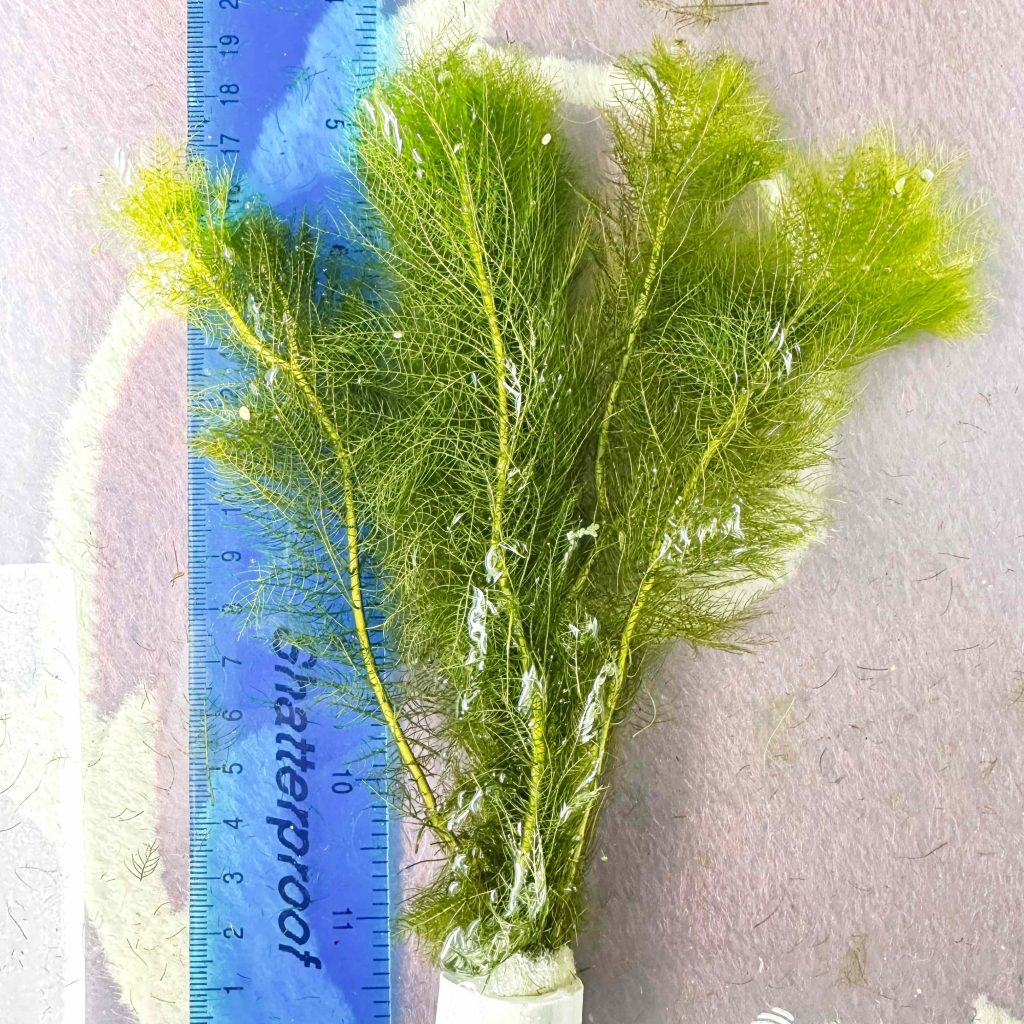
The first thing you notice about M. matogrossense is the leaf structure. Unlike the broad leaves of an Amazon Sword or the simple stems of a Bacopa, Myriophyllum features pinnate leaves. We’re talking about ultra-fine, needle-like leaflets that radiate from a central stem, giving it a soft, feathery, almost cloud-like appearance.
In an aquascape, this is a massive tactical advantage. Because the texture is so fine, it creates an incredible sense of scale. If you plant a thicket of this in the background of a 10-gallon tank, it makes the aquarium look twice as deep as it actually is. It provides a soft “blur” that works perfectly as a backdrop for hardscape like jagged Ohko Stone or dark Driftwood.
Why Your Water Column Needs This Plant
Let’s get into the “why” behind its reputation as a biological filter. Myriophyllum is a notorious nutrient sponge. Because of its incredibly high surface area (thanks to those thousands of tiny leaf needles), it has a massive amount of “real estate” to interact with the water column.
The Algae-Busting Bio-Machine
If you are struggling with a new tank cycle or a sudden spike in nitrates, this is the plant you want on your side. Its metabolism is high. As it races toward the light, it aggressively pulls nitrogen and phosphates out of the water. In a heavily planted Myriophyllum tank, algae often struggle to get a foothold simply because the Myriophyllum is “eating” all the food first. It’s essentially a living, breathing auxiliary filter that looks better than any canister unit ever could.
Oxygenation and Surface Area
Because it’s such a fast grower, its photosynthetic rate is through the roof. On a good day with decent lighting and CO2, you’ll see this plant “pearling” (releasing pure oxygen bubbles) like crazy. This high oxygenation is a godsend for your beneficial bacteria and your livestock. Furthermore, that feathered texture provides a massive surface area for biofilm to grow. If you’re a shrimp keeper, you’ll notice your colonies spending 90% of their time picked into these “feathers,” grazing on the microscopic snacks that thrive there.
Technical Needs: Green vs. Red
While they share the same DNA, the Green and Red variants have slightly different “personalities” that you need to account for if you want them to thrive long-term.
Myriophyllum matogrossense ‘Green’
This is the “easier” sibling. It is remarkably adaptable. Even in a low-tech setup without pressurized CO2, the Green variant will usually grow well, provided you have decent light. It stays a bright, refreshing lime green that pops against dark substrates. It’s less picky about water hardness and can tolerate a wider range of temperatures, making it the perfect “entry-level” feathered plant.
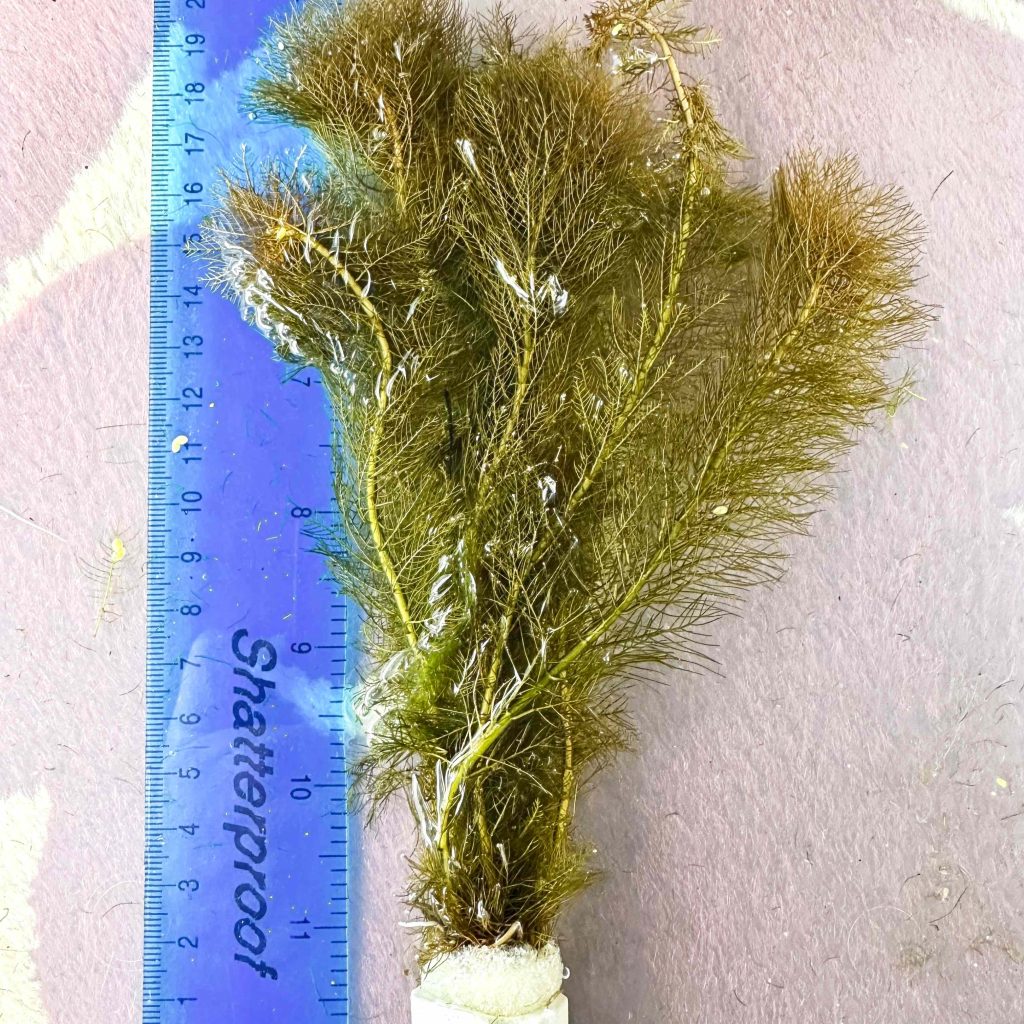
Myriophyllum ‘Red’ (The Specialist)
The Red variant is a bit more of a diva, but the payoff is worth it. To get those deep, rusty reds and bronzes, you have to play the lighting game. Under low light, it will turn a muddy brownish-green and start to “stretch” (increasing the distance between leaf nodes). To keep it compact and vibrant, you need high-intensity lighting and, ideally, a consistent CO2 injection. It also responds heavily to iron supplementation; if the tips look pale or yellowish, it’s a clear signal that your micro-nutrient dosing is lagging.
Practical Application and Maintenance
Because this plant grows like a weed, you can’t just “plant and forget.” You have to be the boss of the tank.
- Placement: These are strictly background plants. They grow tall and they grow fast. If you put them in the midground, they will swallow your layout in a fortnight.
- The “Top and Replant” Method: Like most stem plants, the bottom part of the stem can eventually get “woody” or lose leaves if it’s shaded out by the top canopy. The best way to maintain a Myriophyllum forest is to snip the top 4–6 inches and replant the tips. The tips are always the most vibrant and have the tightest leaf spacing.
- Flow Matters: Because the leaves are so fine, they can act as a mechanical filter, trapping floating debris (detritus). You want a decent amount of water movement around these plants to keep the “feathers” clean. If they get clogged with gunk, the leaves can rot or become a magnet for BBA (Black Brush Algae).
Final Thoughts:
Whether you go for the lush, forgiving Green or the high-impact, technical Red, Myriophyllum matogrossense is a plant that rewards the observant hobbyist. It tells you exactly how it’s feeling through its color and growth rate. It’s a tool for water purification, a sanctuary for your shrimp, and a masterclass in textures for your aquascape. If you’ve got a gap in your background that needs filling, this feathered beast is the answer.
