Hygrophila sp. ‘Chai’
INTRODUCTION
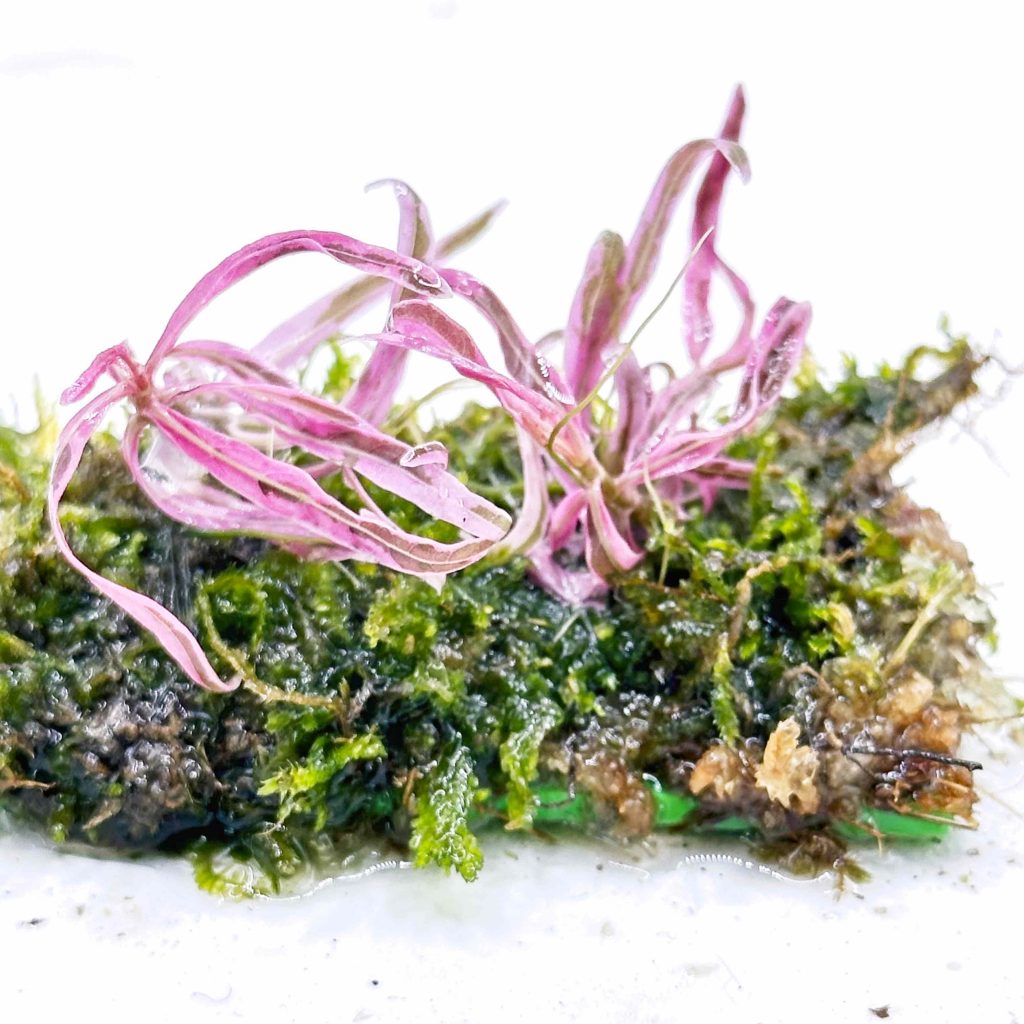
In the hierarchy of rare aquatic plants, Hygrophila sp. ‘Chai’ sits firmly at the top. It is a striking, variegated mutation of Hygrophila araguaia, discovered and stabilized in a laboratory setting. Unlike almost any other plant in the hobby, ‘Chai’ features a shocking, neon-pink coloration that looks almost artificial.
The leaves are narrow and pointed, with a dark, olive-green to brownish center stripe bordered by wide, brilliant pink margins. It is a “statement plant” in every sense of the word, providing a color palette that was once thought impossible for a freshwater aquarium.
QUICK GUIDE
| Feature | Requirement / Detail |
| Difficulty | Advanced / Expert |
| Growth Rate | Slow |
| Placement | Midground / Foreground Accent |
| Light Requirements | Very High (Intense) |
| Temperature | 22°C – 26°C (72°F – 79°F) |
| pH Range | 6.0 – 7.0 |
| CO2 Requirement | Mandatory (High Concentration) |
IN THE WILD
As a specialized cultivar, ‘Chai’ does not exist in the natural world. However, its parent plant, Hygrophila araguaia, is native to the Araguaia River system in Brazil.
- The Mutation: ‘Chai’ is a variegated “sport.” In nature, such a plant would likely perish because the lack of chlorophyll (the pink areas) makes it less efficient at producing energy.
- Habitat Traits: Its lineage comes from riverbanks where it grows both submersed and emersed. This means it has a robust stem structure, but because of its variegation, it lacks the aggressive growth typically associated with other Hygrophila species.
IN THE AQUARIUM
Keeping ‘Chai’ is a badge of honor for many high-tech aquascapers. It is a demanding species that requires a fine-tuned environment to maintain its neon glow.
- Light Intensity: This is not a “low-tech” plant. To keep the pink margins from fading or turning white, you need high-end LED lighting. Without enough light, the plant will quickly “melt” or lose its lower leaves.
- CO2 and Flow: High CO2 (30ppm+) is mandatory. Because ‘Chai’ grows slowly, it needs a constant supply of carbon and excellent water circulation to ensure nutrients reach every leaf and to prevent algae from settling on its delicate foliage.
- Nutrient Regimen: It is a heavy feeder. Iron (Fe) is essential for the pink pigmentation, while a steady supply of Potassium (K) and Phosphates (PO4) ensures the stems remain strong.
- Water Stability: ‘Chai’ is highly sensitive to fluctuations. Sudden shifts in KH or temperature can trigger a total melt of the variegated tissue.
PROPAGATION
Because ‘Chai’ grows significantly slower than the standard H. araguaia, propagation must be done with extreme care:
- Establishment: Only attempt to propagate once the plant is showing active new growth and the stem is at least 10 cm tall.
- The Cut: Use sharp, sterilized aquascaping shears to cut the top 4–5 cm of the stem.
- Lower Leaf Removal: Carefully strip the leaves from the bottom 1 cm of the cutting, being careful not to crush the delicate stem.
- Replanting: Use pinsettes to place the cutting into a nutrient-rich substrate.
- Regrowth: The bottom portion of the original plant will sprout new side shoots. Do not move the “mother” plant, as the root system is vital for the recovery of these new shoots.
MY OBSERVATIONS
‘Chai’ is the “Ferrari” of aquarium plants—it looks incredible, but it requires high-performance maintenance. In my experience, it looks best when planted against a pitch-black background or a dark stone like Black Lava Rock. The contrast makes the pink look like it’s glowing from within.
Pro-Tip: Watch the tips of the leaves. If the pink margins begin to turn transparent or “mushy,” it is usually an early sign that your CO2 levels are dipping or your light intensity is insufficient. Catching this early can save the colony from a total collapse.
BUYING OPTIONS
Due to its delicate nature, we offer ‘Chai’ in two formats designed to give you the best chance of success:
1. Tissue Culture
Because ‘Chai’ is so susceptible to stress and pests, tissue culture is the gold standard for this species.
- Sterile Environment: 100% free of snails, algae, and parasites.
- Acclimation: These plants are already adapted to submersed-like conditions, reducing the “melt” period often seen with farm-grown stems.
- Best for: Nano tanks and high-tech scapers who want a clean, lab-grade start.
2. 6×4 Living Mats
A “safety net” for the ambitious hobbyist.
- Root Stability: Instead of planting fragile individual stems that might float away or rot, the mat provides a massive, established root network.
- Instant Grouping: ‘Chai’ looks best in a dense bush. The mat provides that density immediately, creating a solid block of pink that would otherwise take months of careful growth to achieve.
- Best for: Large display tanks or those who want to skip the “fragile phase” of individual stem planting.
