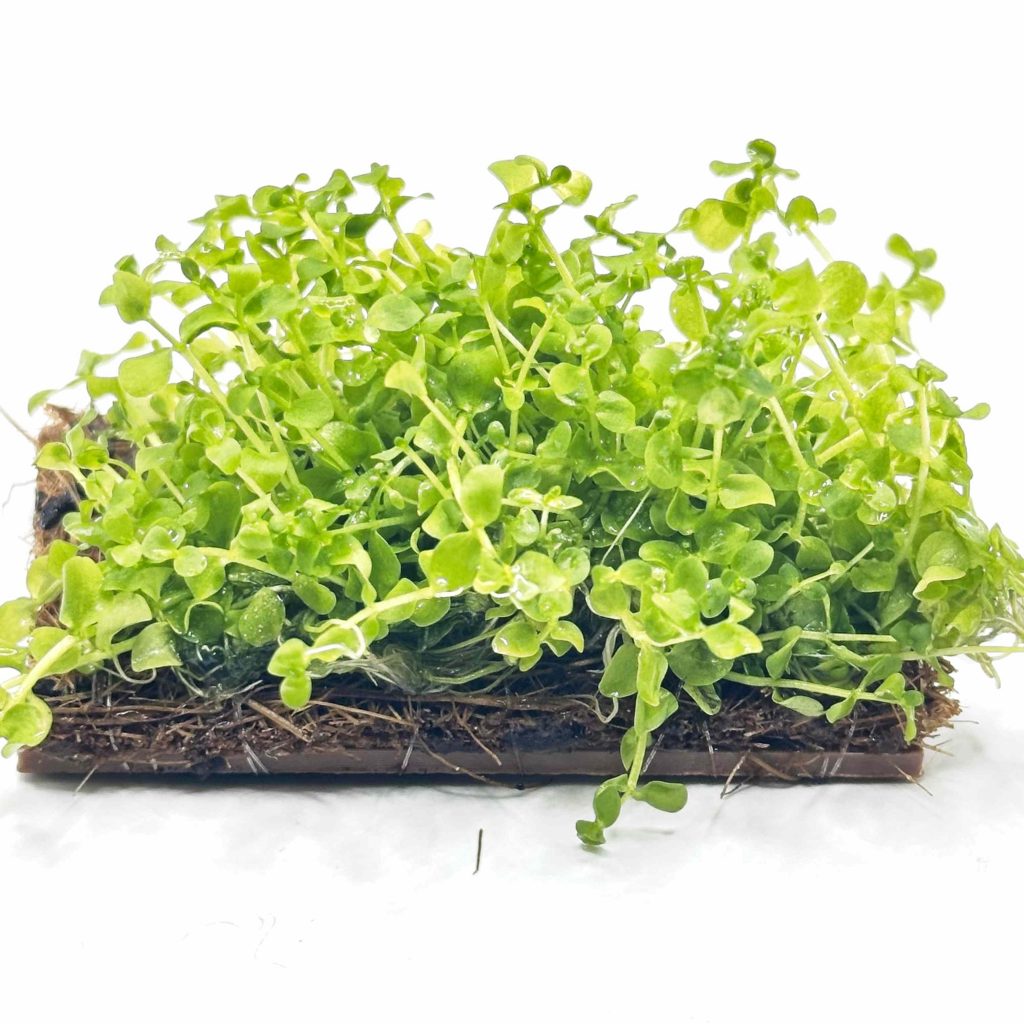
If you’ve spent any time watching aquascaping videos, you’ve seen those perfect carpets.
Bright green.
Dense.
Pearling.
Flawless.
Plants like Micranthemum tweediei (Monte Carlo) and Hemianthus callitrichoides (HC Cuba) are everywhere.
And yes — they can look incredible.
But after growing, trimming, replanting, selling, and occasionally fighting with both of them for years, I can tell you this:
There are a few things people don’t talk about enough.
Monte Carlo – The “Easy” Carpet (With Conditions)
Monte Carlo is often described as one of the easiest carpeting plants in the hobby. And compared to HC Cuba?
That’s true.
It has:
- Slightly larger leaves
- Stronger rooting
- Better tolerance of varied parameters
- A bit more forgiveness
It originates from Argentina and spreads by sending runners across the substrate. Given time, it forms a lush, soft green mat.
But here’s the reality:
“Easy” doesn’t mean “set and forget.”
It still needs:
- Medium to high light
- Nutrients in the substrate
- Stable parameters
- Preferably CO₂ (at least during establishment)
Can it grow without CO₂? Yes. I’ve done it. Others have done it.
But growth is slower.
Recovery is slower.
Mistakes show up faster.
Why Monte Carlo Turns Brown (And It’s Usually Your Fault… Sorry)
If your Monte Carlo starts turning yellowish or brown, it’s usually one of five things:
1. Light Issues
Too little light → leaves die off
Too much light without nutrients → stress & algae
Carpet plants are light-hungry. Weak lighting almost always shows up in the foreground first.
2. CO₂ Imbalance
You can grow Monte Carlo without CO₂.
But if:
- Light is strong
- Fertilisers are consistent
- And carbon is limited
You’ll get instability. Browning is often stress from imbalance rather than one single missing element.
3. Nutrient Problems
If dosing drops off or becomes inconsistent, carpets show it quickly. They’re fast growers — they consume nutrients aggressively when healthy.
4. New Tank Melt
This one’s common.
Monte Carlo can take weeks — even a couple of months — to truly settle in. During that adjustment phase, it can look rough.
If parameters are stable, it often corrects itself.
5. The Big One Nobody Mentions: Waste Build-Up
This is the part most aesthetic aquascape videos skip.
Both Monte Carlo and HC Cuba create extremely dense root systems.
When they mature, they form a thick, interwoven matrix.
It looks beautiful on top.
Underneath?
It can become a detritus trap.
Food.
Fish waste.
Organic debris.
Dead plant matter.
All of it gets caught in that root network.
And because the carpet is so dense:
- Flow doesn’t reach the substrate properly
- Waste settles underneath
- It slowly decomposes
- Ammonia pockets can form
- Algae and instability follow
I’ve lifted established carpets before and found far more waste underneath than people would expect — even in tanks with decent filtration.
It’s basically a sponge sitting on your substrate.
Why Thick Carpets Can Become a “Time Bomb”
If you never thin, lift, or manage a dense carpet:
- Detritus builds up underneath
- Bacteria break it down
- Nutrients accumulate
- Water quality can suffer
Even regular water changes don’t remove what’s physically trapped under the plant mass.
And you can’t aggressively gravel vac without destroying the carpet.
So what’s the solution?
- Regular trimming (don’t let it get too thick)
- Strong filtration
- Good flow across the substrate
- Occasional thinning or lifting sections
- Avoid overfeeding
Carpets are beautiful — but they’re not zero-maintenance.
HC Cuba vs Monte Carlo – The Reality
From my experience:
| Trait | Monte Carlo | HC Cuba |
|---|---|---|
| Difficulty | Moderate | High |
| Root strength | Stronger | Very delicate |
| CO₂ demand | Helpful | Almost essential |
| Tendency to peel | Low | High |
| Waste trapping | High when thick | High when thick |
HC Cuba is more fragile. If you trim it too late, it can peel away entirely.
Monte Carlo is sturdier — but when it gets very dense, it can trap just as much waste underneath.
Different personalities.
Same long-term maintenance issue.
Why I Sell Carpets as Pre-Prepared Mats
After dealing with:
- Floating plugs
- Slow establishment
- Early melt
- Uprooting during first trims
- Inconsistent spreading
I changed how I grow and sell these plants.
Instead of tiny, loose portions that customers have to separate and plant stem by stem…
I grow them into dense, interwoven mats first.
By the time I sell them:
- The root structure is already established
- The runners are already connected
- The carpet is stable
- It’s far less likely to float or lift
- Establishment time in your tank is reduced
It doesn’t remove the need for proper lighting or maintenance.
But it skips the most fragile stage — the part where most failures happen.
You’re starting with a functioning mini-carpet rather than hoping loose fragments knit together.
My Honest Take
Carpeting plants are not beginner plants.
They’re stable-tank plants.
If your tank:
- Has inconsistent dosing
- Weak flow
- Overfeeding
- Poor filtration
A dense carpet will expose those weaknesses.
If your tank:
- Is mature
- Is balanced
- Has good maintenance
- Has proper light
They can be stunning and very rewarding.
But they’re not “drop in and forget” plants — no matter how effortless YouTube makes them look.
And if you’re going to grow them?
Trim them.
Thin them.
Respect what’s happening underneath.
Because what’s under the carpet matters just as much as what’s on top.
