If you grow Hemianthus callitrichoides — HC Cuba — long enough, you’ll eventually learn this the hard way:
It’s not the cutting that ruins your carpet.
It’s the timing.
I’ve watched countless videos over the years, including demonstrations from brands like Aqua Design Amano, and one thing always stands out — professionals don’t trim differently.
They just trim earlier.
And they manage the tank properly afterwards.
The Biggest Mistake: Waiting Too Long
This is where most hobbyists go wrong.
You finally get that beautiful, full, lush carpet. It’s thick. It’s pearling. It looks incredible.
And you think:
“I’ll leave it a bit longer.”
That’s the moment you’ve already gone too far.
If HC gets too thick:
- The bottom layer stops getting light
- It starts to yellow and wither underneath
- Gas gets trapped
- Roots stay shallow
- The entire carpet can peel away when trimmed
If your HC feels springy when you press it and you can’t feel the substrate beneath it — you’re late.
If you press down and feel the soil underneath? Perfect timing.
That little test alone can save your carpet.
Don’t Be Afraid to Cut It Hard
Another big mistake?
Trimming too lightly.
When I trim HC, I cut it properly — near the base. Not a light haircut.
If you only skim the top:
- It thickens again too quickly
- The lower section dies
- It eventually detaches
A deep, confident trim keeps it compact and healthy.
It actually makes maintenance easier long-term.
Why Carpeting Plants Are Different
With stem plants like Rotala rotundifolia, you can be aggressive. They root deep and recover easily.
HC doesn’t.
Its roots are fine and shallow. That’s why timing matters so much more with carpets.
You don’t get the same margin for error.
The Part Nobody Talks About: What Happens After Trimming
This is the real secret.
When you heavily trim HC, you’ve just removed a huge percentage of the plant mass that was absorbing nutrients.
Suddenly:
- Nutrient uptake drops
- Excess nutrients remain in the water
- Algae gets an opportunity
And that’s why people say:
“Every time I trim HC, I get algae.”
It’s not the trimming.
It’s the imbalance afterwards.
Whenever I trim heavily, I:
- Do a large water change immediately
- Remove all floating debris
- Temporarily reduce liquid fertiliser
- Increase water changes for the next week or two
Because for a short period, the carpet simply cannot consume nutrients at the same rate.
Once it regrows, you can return to normal dosing.
Ignore this step, and algae can take over fast.
Why This Changed How I Sell HC
After years of growing Hemianthus callitrichoides, trimming it, replanting it, watching it peel, regrow, and stabilise — I realised something.
The hardest stage isn’t long-term maintenance.
It’s establishment.
Tiny plugs are incredibly fragile:
- Easy to float
- Easy to disturb
- Easy to uproot during early trims
- Easy to lose to algae before they knit together
That’s exactly why I grow and sell HC as pre-prepared mats.
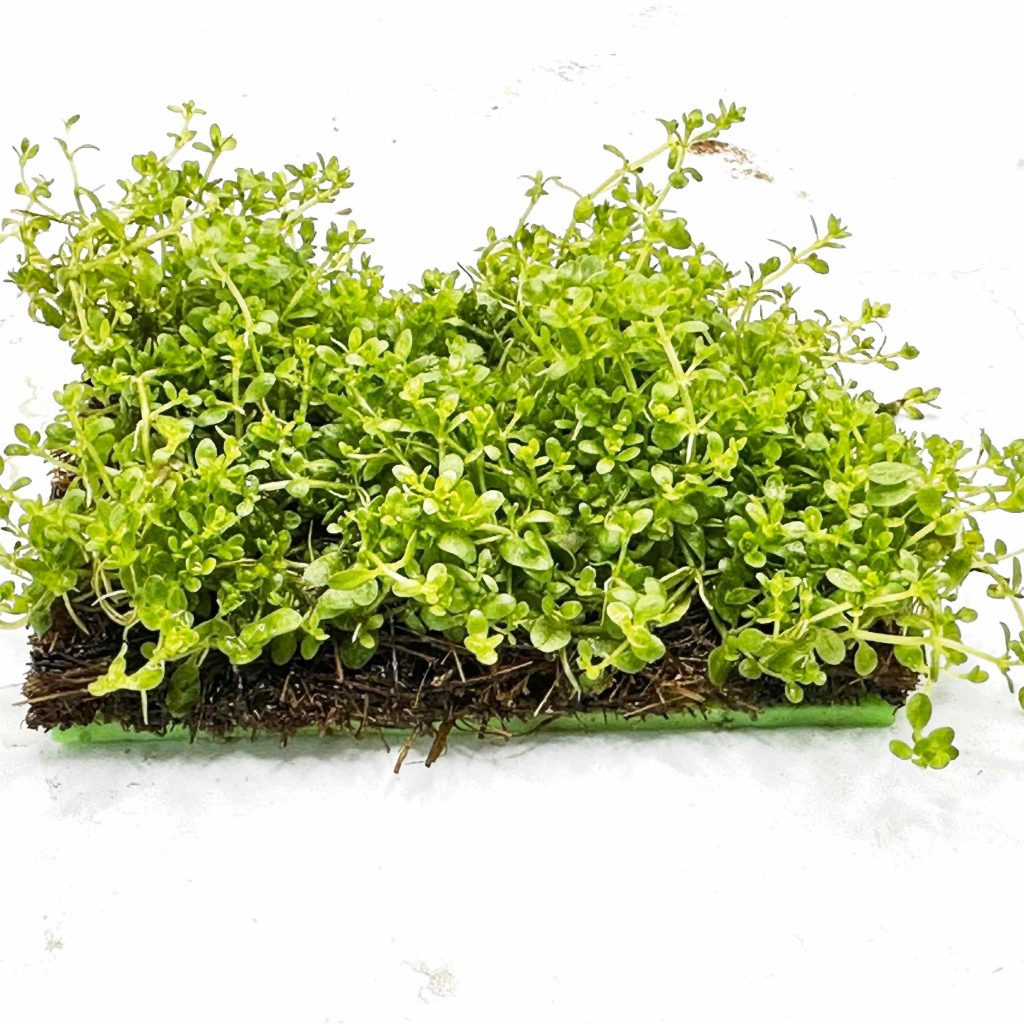
Instead of sending out tiny separated portions that need to knit together from scratch, I grow them into dense, interwoven carpets first.
When you receive one of my mats:
- The roots are already connected
- The structure is already stable
- The carpet is already thick and established
- It’s far less likely to peel during early trims
You’re skipping the most failure-prone phase entirely.
It doesn’t make HC beginner-proof — it still needs strong light and CO₂ — but it massively improves your odds.
Final Thoughts
There’s no magic trimming technique.
No secret professional scissor angle.
Even curved scissors — like the well-known ADA-style wave scissors — just make it easier to reach flat surfaces. They’re helpful, but they’re not the secret.
The real keys are simple:
- Trim earlier than you think
- Trim deeper than feels comfortable
- Manage nutrients immediately afterwards
If you get those three right, HC stops being “impossible” and starts being manageable.
And if you start with a properly established mat instead of fragile fragments?
You’re already ahead.
That’s been my experience — and it’s exactly why I prepare them the way I do.
