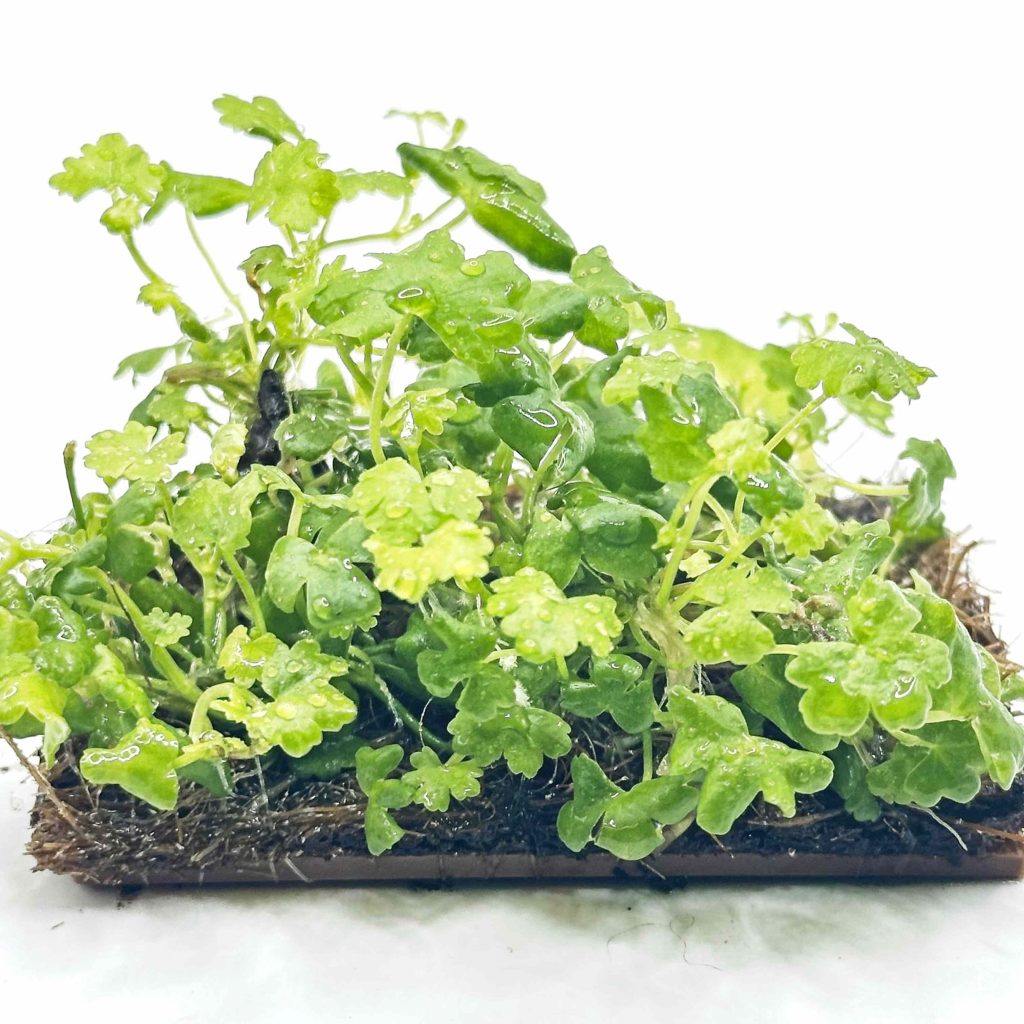
If I had to recommend one plant to someone setting up their first tank, it would be Hydrocotyle tripartita.
No hesitation.
It’s fast. It’s forgiving. It grows almost anywhere. And if you let it, it will completely take over your aquascape (in a good way… mostly).
I’ve used it in more layouts than I can count, and every time I’m reminded why it’s such a beginner-friendly powerhouse.
Let’s break down why this plant deserves a spot in your tank.
First Impressions – What It Actually Looks Like
Hydrocotyle tripartita has that bright, fresh green colour that instantly makes a tank feel alive.
The leaves look like tiny three-leaf clovers. Not grass. Not blades. Not fine carpeting stems. Little clover shapes on creeping vines.
It grows low if you trim it often — around 2–10 cm — but if you ignore it, it will start climbing, stretching, and reaching for light like it has somewhere important to be.
I always compare it to ivy. It creeps. It climbs. It finds gaps. It fills spaces you didn’t even plan to plant.
And that’s exactly why I like it.
Tripartita vs “Japan” – Are They Different?
You’ll often see it sold as:
- Hydrocotyle tripartita
- Hydrocotyle “Japan”
For a long time, I honestly thought they were the same thing with different labels.
Technically, tripartita originates from Australia (wetlands, stream banks, damp environments). The “Japan” version is often described as a cultivated or aquarium-adapted variant.
Some people swear there’s a size difference. Some say one is better for paludariums.
Personally? In real-world aquarium conditions, they look almost identical unless you’re studying them with a magnifying glass.
In good conditions, either one will thrive.
Why It’s Perfect for Beginners
1. It Grows Fast (Like… Really Fast)
Under high light, CO₂, and fertilisers? It explodes.
But here’s the best part:
It doesn’t need all of that.
Will it grow faster with CO₂ and strong lighting? Absolutely.
Will it still grow in a low-tech tank? Yes — just a bit slower and leggier.
Because it grows so quickly, it’s fantastic for helping prevent algae. Fast-growing plants consume nutrients before algae can take advantage of them.
Important note: It helps prevent algae. It won’t magically cure an existing outbreak.
I always say every aquascape should have at least one fast grower. This is a perfect candidate.
Where Can You Put It?
Short answer?
Pretty much anywhere.
Foreground
It can create dense clover-like carpets. Not grass-style like Eleocharis — think more of a compact clover lawn.
The more you trim it, the denser it becomes.
Midground
This is one of my favourite uses.
Let it peek through driftwood gaps or weave between rocks. The vine-like growth gives a natural, slightly wild look.
Background
Unusual? Yes.
Effective? Also yes.
Let it climb vertically and it gives off a slightly untamed jungle vibe.
On Hardscape
You can:
- Tie it to driftwood
- Glue it to rocks
- Wedge it into crevices
- Press it between stones
It will grab hold with roots surprisingly quickly.
It even works in paludariums, terrariums, and pond-style setups. You can grow it immersed or submerged. You can even let it float.
It’s honestly one of the most adaptable aquarium plants out there.
Planting It Properly (So It Doesn’t Melt on You)
If you’re planting it in substrate:
- Use tweezers.
- Separate it into small clumps.
- Space them slightly apart.
- Press stems into the substrate but don’t bury the leaves.
Planting too densely can cause shading and die-off underneath.
If attaching to hardscape:
I usually let it grow stronger in the substrate first. Once it’s established, I cut a larger clump and glue or tie it like moss.
Fresh store-bought pieces sometimes struggle if glued immediately.
Don’t Be Afraid to Trim It
This is where beginners hesitate.
“It looks so good… what if I cut it and ruin it?”
Trust me.
It loves trimming.
If you don’t trim it:
- The bottom layers get shaded.
- The lower parts start weakening.
- It can detach or rot underneath.
- It may strangle nearby plants (yes, it will wrap around stems).
Trim above the substrate for a clean carpet.
Let some vertical tufts grow if you want a wild, natural look.
Cut runners early if they’re escaping your layout. Replant the cuttings to thicken empty areas.
Propagation is ridiculously easy.
Propagation – Almost Too Easy
You literally:
- Cut a runner.
- Replant it.
- Done.
That’s it.
One pot can fill an entire aquarium if you’re patient.
Just don’t plant 1 cm fragments — use decent-sized cuttings so they establish properly.
Water Parameters & Conditions
It’s not fussy.
- Temperature: 20–28°C
- pH: 6.0–7.5
- Soft to medium hardness preferred
Main requirement?
Light.
It needs decent light. Without it, growth becomes pale and stretched.
In high-tech setups (strong light + CO₂ + fertilisers), it becomes compact and dense.
In low-tech tanks, balance is key. If you’re not dosing fertilisers, make sure you have enough fish to provide nutrients. Too few fish and too many water changes can leave plants starving.
Balance always matters.
The Only Real Downside
It can get out of control.
It sends runners daily. It climbs rocks. It wraps around stems. It shades slower plants.
If you’re not trimming regularly, it will start designing the tank for you.
But honestly?
That’s a good problem to have compared to plants that refuse to grow.
Final Thoughts
If you’re a beginner and you want:
- A fast grower
- An algae-preventing helper
- A versatile design plant
- Something forgiving
- Easy propagation
- Foreground, midground, background flexibility
Hydrocotyle tripartita is a no-brainer.
Plant it in substrate first.
Let it establish.
Trim confidently.
Replant cuttings.
Guide it where you want it.
Or let it go a little wild.
Either way, it’s one of the easiest and most rewarding plants you can add to your aquarium.
If you don’t already have it… you probably should.
